Learn About Satya

See How Satya Works In Two Minutes.

One application, the banks you choose and offers compared in one place: start here, then watch the parts that matter to you.

Film Language

Applies to every film on this page.

Shared With You

English captions

3:20

Satya for Banks and Financial Institutions

Narration
English
Subtitles
  • English captions, always on

For banks, hire-purchase companies and other financial institutions: meet your next borrower through organized applications, follow up where information is missing, and keep every lending decision.

Read the Transcript

For banks, hire-purchase companies and other financial institutions: meet your next borrower, on your terms.

For banks and financial institutions, Satya is a new channel for your lending team. Applications arrive organized, you can follow up on what's missing, and you keep control of pricing, conditions and approval.

Borrowers prepare one application and choose which institutions receive it. It reaches you only with their permission.

Before it reaches you, the application is prepared. The borrower uploads their documents, Satya reads them, and the borrower compares every detail with the original, corrects it, and confirms. Property documents, like the Lalpurja, are read and confirmed by the borrower too. For vehicle finance, the borrower brings the dealer's quotation, so you can understand the vehicle, the price and the proposed down payment alongside the application.

They choose which institutions receive it, and consent before anything is shared.

Then it reaches your team. Applications shared with your institution arrive organized: borrower details, documents and the loan request, together. Your team sees what the applicant declared beside the documents they submitted, with a prompt for what to check first. Property documents arrive with the application, along with what the applicant confirmed.

If information is missing, ask for it. Requests stay connected to the application. Risk insights bring four categories into one score, and show the figures behind it. Your bank can set its own weights. A score supports your review; it is not an approval.

And the decision stays yours. Your bank applies its own verification, credit policy and pricing, and makes its own lending decision. Your offer appears in one place, beside any others, where the borrower compares the full terms. When a borrower accepts your offer, you continue with them through your own process, and your bank handles the payment.

Trust is built in.

Access is tied to authorized roles and the applications shared with you. Submissions are preserved, file access is audited, and Satya does not sell personal information.

A new channel, with a familiar decision-maker: you. We welcome conversations with Nepal Rastra Bank–licensed banks and hire-purchase companies. Partner with Satya at satyafinancial.com.

Scan the code to stay in touch with Satya. It takes about a minute.
Watch in Parts

Pick the Part That Matters to You.

Each part plays from its start and pauses at its end.

15:14

The Satya Product Demo

Narration
Subtitles
  • English
  • नेपाली
  • English + नेपाली

A complete walkthrough: a borrower's personal loan from the first sign-in to the payout, every step in the bank's workspace, and how Satya is built for trust. Choose English or Nepali subtitles, or both, in the player or the download.

Read the Transcript

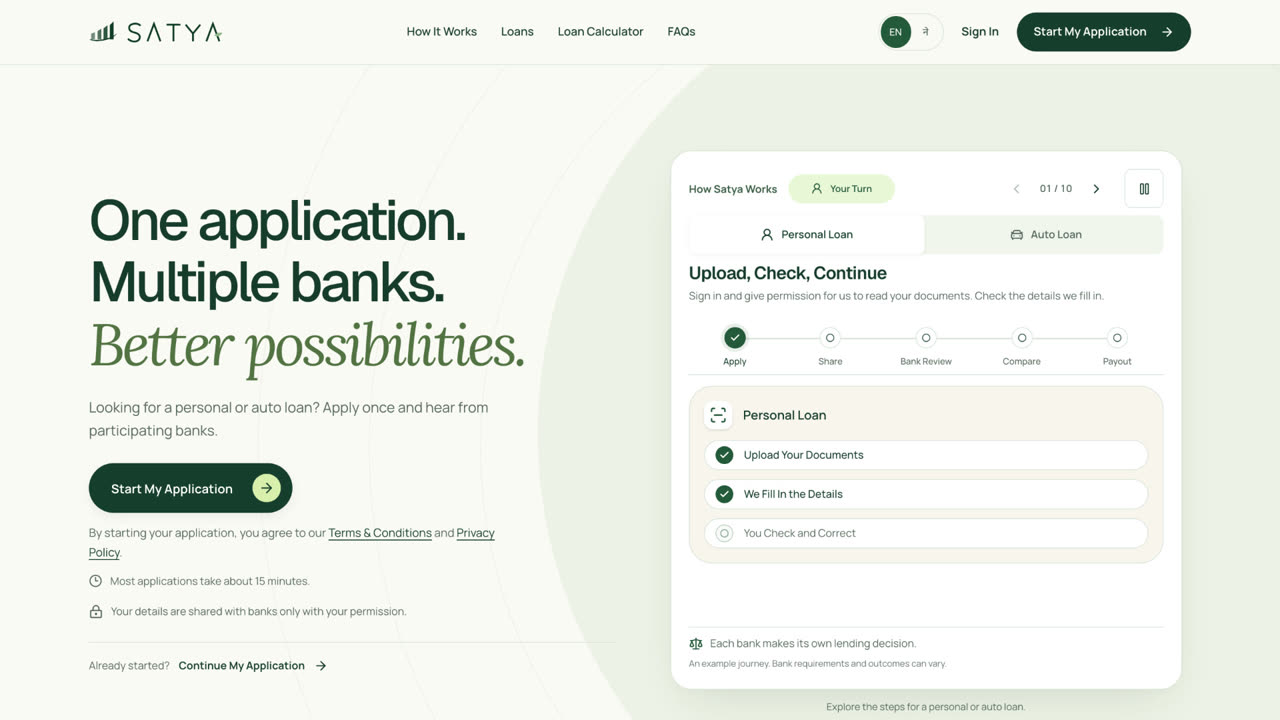
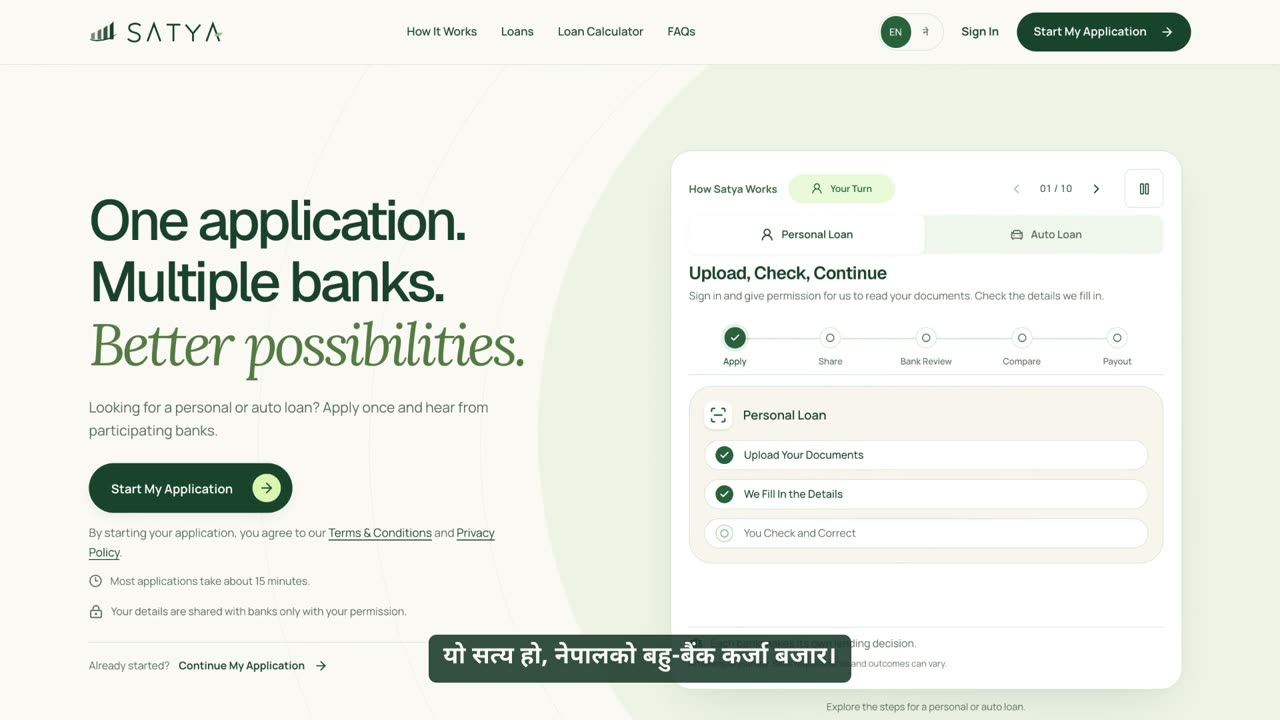
Welcome to Satya, Nepal's multi-bank loan marketplace.

In this demo, we'll follow one personal loan from the first sign-in all the way to the payout. Along the way, we'll see everything a bank does.

We'll go in four parts. First, the borrower's journey, from signing in to sharing the application. Second, the bank's workspace, where the application is reviewed. Third, offers and the payout. And finally, how Satya is built for trust.

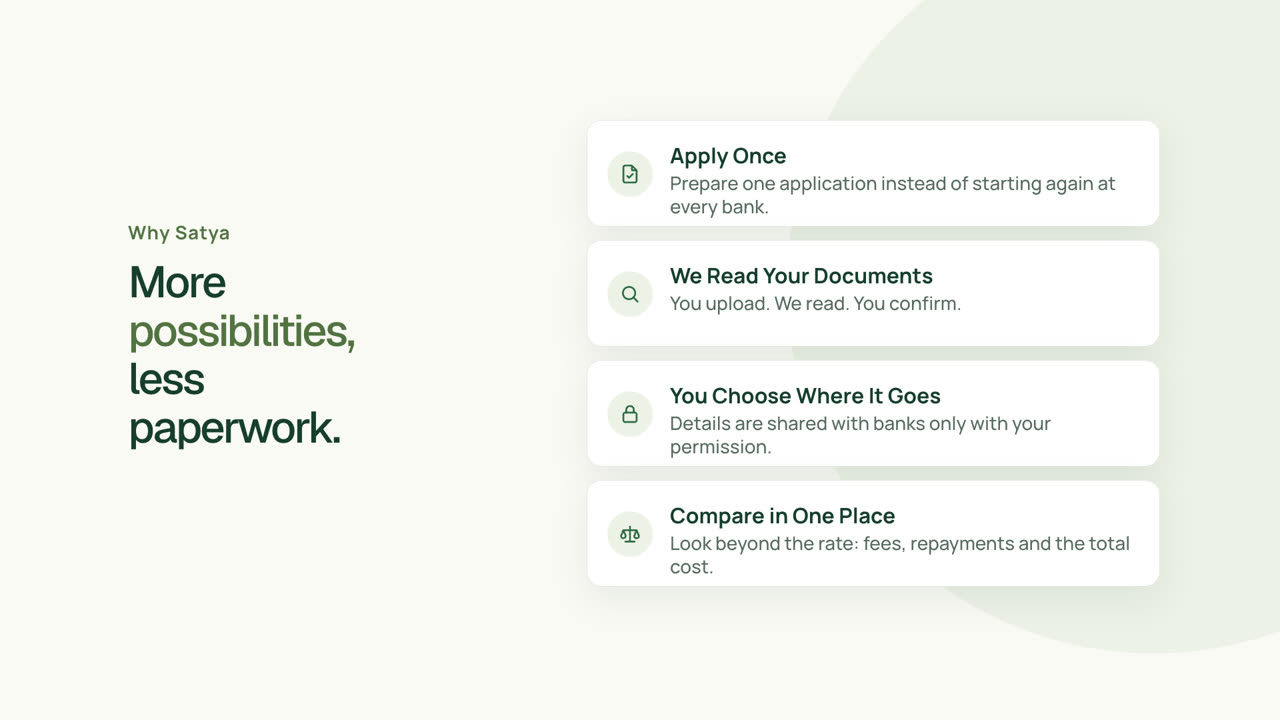
Why does this matter? Applying for a loan often means starting the same conversation again, at every bank: the same details, the same documents, the same plans. With Satya, you prepare one application, and Satya reads your documents. You choose where to share it, and you compare the offers you receive in one place. Satya works in English and in Nepali. One tap switches the whole experience, from the first page to the application.

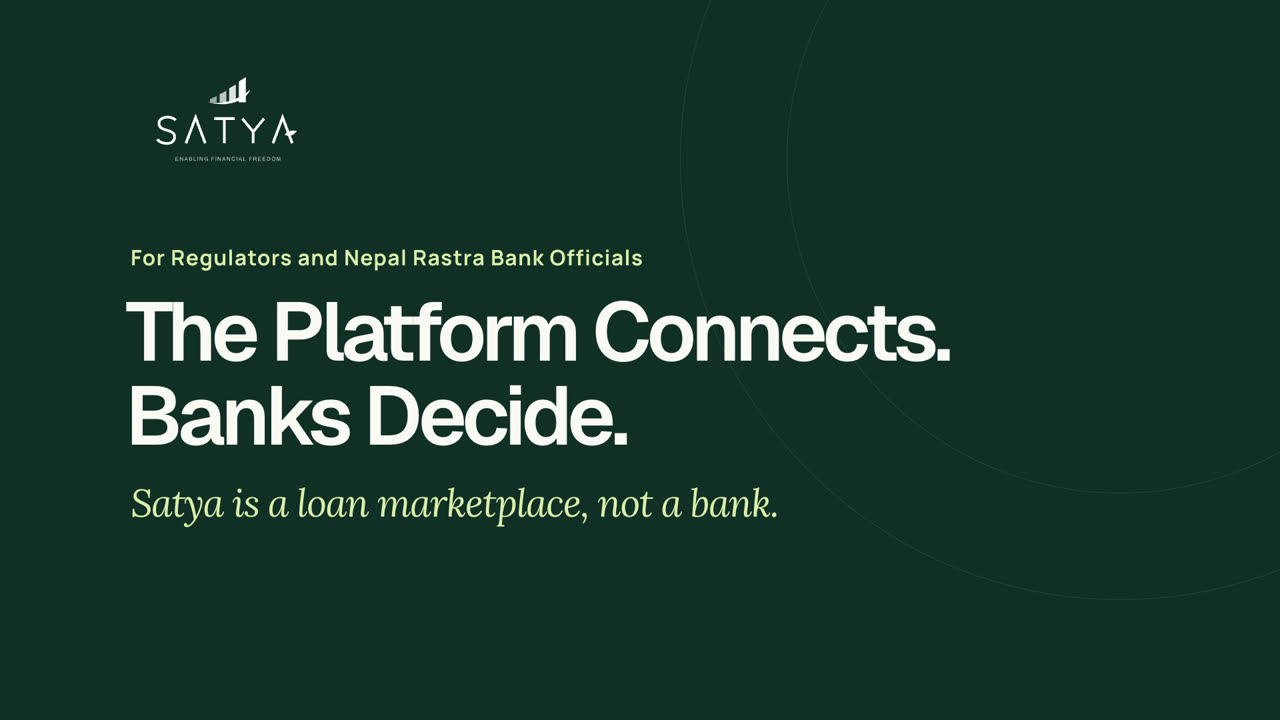
Here's the idea. A borrower prepares one application, checks every detail, and chooses which banks may see it. The platform connects; each bank decides.

Part one: the borrower. Meet Bikash Shrestha. He wants five lakh rupees to improve his home.

It starts with his account. Bikash signs in with his Google account; there's no new password to remember. Satya asks what he's here to do, a personal or a business workspace, and he sets up a personal one. Before his first upload, Satya asks for permission to store and read his documents. It explains exactly what that means, and that it's separate from sharing anything with a bank.

Next, his identity. He uploads the front and back of his citizenship certificate, as a photo or a PDF. He can use his phone or his computer. Each side shows its progress, and he can replace a file at any time. Satya reads the certificate and fills in the details. There's his name in English and in Nepali, his date of birth and his permanent address. He compares each one with the original, corrects anything that's off, and confirms. His National ID works the same way. He can use the card itself or the application copy, and the option he leaves selected is the one that counts.

When two documents disagree, Satya doesn't guess. It flags the difference, here in his first name, and he reviews it before anything moves forward. Everything lives in his workspace. He uploads, Satya reads, and he confirms. He stays in control of every correction, and of what gets shared. Over time, his workspace builds a profile he can reuse. Identity, contact details, address, family, income, borrowing goals and collateral each have their own section. His documents page keeps every file in one place. Files are grouped into identity, household, income and optional documents, ready for his next application too.

Now he starts a personal loan. Satya lists the extra documents it will need, and asks for his consent to prepare the application. Nothing is sent to a bank at this step.

Then, a few questions about him, his family and his income. He confirms how he can be reached about his application: his mobile number and his email address. Updates about his application come to this number. He says what he does: employed, unemployed or studying, and what kind of work. That way, the application asks only for the income documents that fit. One question at a time. He's married, so Satya will ask for his marriage certificate, and nothing he doesn't need.

Every borrower provides a family relationship certificate, the Nata Pramanit. Because he's married, he also adds his marriage certificate. He uploads his family relationship and marriage certificates. Satya reads the names, and he checks each family member before confirming. He confirms his current address from a proof of address: province, district, municipality and ward, each checked against the document. For his income, he uploads his income certificate and his tax deduction certificate. Every source of income stays with its own document.

Satya reads his monthly and total income, the tax deposited and his employer. Bikash confirms each value. The bank will later see exactly what he confirmed, right beside the documents themselves. He adds a recent bank statement. Satya reads the account details and the statement summary, so nobody has to type them again. He declares any monthly debt payments, on loans, credit cards or anything else. Bikash has none.

Now, the loan itself. He chooses what the loan is for. The choices include a home, land, education, healthcare, a vehicle, combining debts or a family milestone. For Bikash, it's improving his home. He asks for five lakh rupees, and picks a repayment period of thirty-six months. These are his preferences; each bank still makes its own assessment. He can also say whether he's interested in other bank products, like a savings account. He can say how he'd like to be contacted, too. It's optional, and it doesn't affect his loan.

He's pledging land. Satya lists what he'll need: his Lalpurja, a land revenue receipt, a blueprint and a four boundary certificate. Then it reads his Lalpurja: the plot, its area and its owner. The land revenue receipt, the Tiro Rasid, is read the same way: the tax paid, the government valuation and the receipt details. The blueprint and the four boundary certificate add the parcel, the survey sheet and the boundaries. Bikash confirms each one before it's used.

Finally, he checks everything before he shares it. The final review shows the whole application, section by section: identity, relationships, addresses, income, the loan and the collateral. Every value is marked as confirmed, so nothing reaches a bank that Bikash hasn't checked himself. He chooses where to send it: specific banks, or every eligible bank shown.

He confirms his declarations and submits. Satya sends this exact application and its documents only to the banks he selected, and keeps a snapshot of what was sent.

Part two: the bank. Let's see what happens at Sample Bank when Bikash's application arrives.

It starts in the bank's lending workspace. The overview shows the bank's own pipeline at a glance. There's the total amount requested, and how many applications are awaiting review, in review, or waiting on more information. Applications are grouped by purpose, and the next one to review is a click away. Here, it's Bikash's personal loan, with his income evidence to compare. The applications list shows every case shared with this bank, with the amount, the product and the review status. Saved views, like Needs Information, help the team pick up where it left off.

Search finds any person, business or case reference across the bank's workspace.

The underwriter opens Bikash's case. The case opens with the request at a glance. It's five lakh rupees for home improvement, over thirty-six months, with his declared monthly income. Satya highlights one thing to look at first, and a review checklist shows what's ready and what's still to do. The Evidence tab compares what Bikash declared with what his documents show. His income needs checking against his bank statement, and the original source opens right in the case. Every document he shared is in the case, grouped by type. The secure viewer shows the original beside the facts he confirmed. It can zoom and rotate, and it watermarks every page.

The Collateral tab breaks his property documents down. There are the land plots, the owners, the location and the document details, each linked to the page it came from. The activity log records what happened and when, from the package arriving to the customer's authorization. A private note keeps context for the bank's own team.

If something is missing, the bank asks. The underwriter describes what's needed, here, bank statements showing his salary credits. The request is tied to the submitted package, and Bikash sees it in his workspace.

Then, the assessment. Satya's risk insights bring four categories together into one score, and show the figures behind it. The bank can set its own weights. A score supports the review; it is not a loan approval. When the underwriter starts the review, the case moves into review, and the activity log records it.

And the decision stays with the bank. In the offer decision workspace, the bank moves from preparing an offer to reviewing, issuing and the borrower's response. It can approve the request as asked, or propose different terms. It sets the amount, the annual rate, the tenure and repayment frequency, an expiry date and any processing fee. It can add a message in English and Nepali. A live calculation previews the monthly installment and the total repayable. Before anything is sent, the bank reviews the exact terms. If it proposes something different from the request, the screen says so, and the message explains why.

Once the offer is issued, the bank can see when the borrower has viewed it, and withdraw it if needed. When the borrower accepts, the offer is locked and can no longer be changed. After acceptance, the bank can prepare draft loan documents, like the loan deed and a personal guarantee, prefilled from the application. Drafts are for the bank's own review, not for signing. And the bank can see how its team is doing. There are first response times, cases responded to and what's still waiting, for each reviewer and the whole team.

Part three: back to Bikash. When banks respond with offers, they come back to one place in his workspace. Each shows its amount, interest rate and how long it's valid. He looks beyond the rate, compares the full terms, and chooses the offer that's best for him. Opening an offer shows its exact terms: the offered amount, how long it's valid, the rate, the tenure and the security. Before responding, he reads the bank's declarations and what accepting will mean.

Accepting is a deliberate step: he confirms he has reviewed the exact terms. His acceptance is recorded against that exact offer, and competing offers are closed. His chosen bank then guides him through the remaining paperwork, directly. Once its conditions are met, the bank pays out the loan, and Bikash receives the amount as agreed. The bank handles the payment; Satya does not transfer funds.

Finally, how Satya is built for trust.

Consent is on record. Every submission is preserved exactly as it was sent, and each bank's access is separate and audited. Satya is a marketplace, not a bank, and it does not move money. Participating banks keep their lending decisions and regulatory responsibilities.

For banks and financial institutions, Satya is a new channel for your lending team. Applications arrive organized, you can follow up on what's missing, and you keep control of pricing, conditions and approval.

Behind every loan is a life moving forward: a home improvement, a family vehicle, a personal goal. Less repetition and clearer choices help more people take that step with a licensed lender. And Satya is built for Nepal's documents and language.

So that's Satya, from start to payout. Documents are read for the borrower and confirmed by the borrower. The application is shared only with the banks the borrower chooses. Banks review organized cases and make their own decisions. Offers come back to one place, all the way to the payout. Satya. One application. Multiple banks. Better possibilities. Start your application, or partner with Satya, at satyafinancial.com.

Scan the code to stay in touch with Satya. It takes about a minute.
Chapters


  1. Welcome to Satya

    Why one application beats starting again at every bank, and how one tap switches English and Nepali.

    Length 1:17

  2. Account and Workspace

    Bikash signs in with Google and gives permission to read his documents, separate from sharing anything with a bank.

    Length 0:38

  3. Identity Documents

    Satya reads his citizenship certificate and National ID, and flags any difference instead of guessing.

    Length 1:50

  4. You, Family and Income

    One question at a time, asking only for the documents that fit his situation.

    Length 1:55

  5. The Loan and Collateral

    He chooses the purpose, amount and term, and confirms what Satya reads from his land documents.

    Length 1:20

  6. Check Before You Share

    He reviews every section, chooses the banks and submits. Satya keeps a snapshot of what was sent.

    Length 0:44

  7. Your Lending Workspace

    The application arrives at the bank organized: borrower details, documents and the loan request, together.

    Length 0:58

  8. Review the Case

    Underwriters see what the applicant declared, right beside the documents submitted.

    Length 1:14

  9. Ask for What's Missing

    If something is missing, the bank asks, and the request stays with the application.

    Length 0:17

  10. See the Score. Understand the Why.

    Risk insights show a score and its reasons. The score supports the review; it isn't a loan approval.

    Length 0:26

  11. Your Policy. Your Decision.

    Each bank applies its own policy, and sends an offer with clear terms.

    Length 1:25

  12. Offers and Payout

    Bikash compares the full terms and accepts. The bank pays out the loan; Satya never moves the money.

    Length 1:09

  13. Built for Trust

    Consent on record, every submitted application preserved, and each bank's access separate and audited.

    Length 2:02

Key Facts

What to Know About Satya.

Consent Before Sharing
Nothing is shared with a bank until the borrower gives consent, and Satya keeps a record of exactly what was sent.
Each Bank Decides
Each bank reviews the application and decides whether to lend, how much to offer, and on what terms.
Satya Doesn't Move Money
Satya is a loan marketplace, not a bank. The bank pays out the loan directly.
About 15 Minutes
Most applications take about 15 minutes. You can save your progress and finish when it suits you.
English and Nepali
Use Satya in the language you prefer. It reads documents in English and in Nepali.

Common Questions

Is Satya a bank?

No. Satya is a loan marketplace that helps you apply to multiple participating banks. Each bank reviews your application and decides whether to lend, how much to offer, and on what terms.

Who will see my documents?

You’ll see which banks will receive your application before you agree to share it. You can check your details and documents first. Permission for other banking services is separate.

Am I guaranteed a loan?

No. Each bank has its own requirements and makes its own decision. If you receive an offer, take time to read the rate, fees and repayment terms before accepting.

Can I finish my application later?

Yes. Your saved application stays in your account. Sign in when you’re ready to pick up where you left off.

What's Next?

Take the Next Step.

Apply for a Loan

Most applications take about 15 minutes.

Start My Application

For Banks and Financial Institutions

Learn about the partnership process and responsibilities.

Explore Partnership

Stay in Touch

Share your details. It takes about a minute.

Share My Details

All Films

Every film can be downloaded and shared.

About These Videos

The people, banks, dealers and offers shown are examples, and some screens may look slightly different in the app today. Each bank makes its own lending decision. Satya is a loan marketplace, not a bank.

Music: “Happy Beats / Business Moves” by Sascha Ende (ende.app), licensed under CC BY 4.0.